Author Archives: Jason C. Morris, Esq.

Community Foundation Recognizes Mr. Ross

Don L. Ross, Esquire, was recognized by the Community Foundation of Western Nevada as a Friend of the Foundation for his devoted service and continued referrals to the Foundation. On September 22, 2010, at the Foundation’s annual banquet, Chris Askin, Executive Director of the Foundation, presented the award to Mr. Ross. The Foundation recognized Mr. Ross for directing a number of his clients to utilize the Foundation’s services to benefit the local community. Mr. Ross has served as a Professional Advisor to the Foundation for several years.

Keep the Estate Tax?

The Wall Street Journal examines whether the estate tax should exist at all: http://bit.ly/bavBH8. The estate tax exemption amount (more properly titled the “exemption equivalent amount”) increased greatly from 2001 until 2009. During the late 1990’s, government economists projected budget surpluses in the coming decade. Therefore, the government sought to cut both income and transfer taxes. What the economists did not forecast was the tech bubble bursting, wars in Iraq and Afghanistan, and the most recent economic recession. Due to Congressional inaction, the estate tax has lapsed this year and the clamor for an outright repeal of the estate tax has heightened. The Journal presents viewpoints supporting the estate tax: http://bit.ly/cCKsx2 and the argument against the estate tax: http://bit.ly/91CnzS.

How the Rich Shield Assets

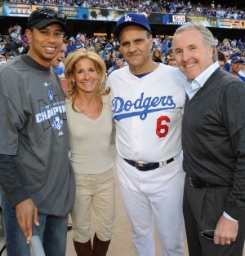
Tiger Woods, Jamie McCourt, Joe Torre, Frank McCourt

Major League Baseball fans might be aware that the ownership of the Los Angeles Dodgers is at stake in the divorce proceedings between Frank and Jamie McCourt. The court filings have included many salacious details: Jamie’s alleged affair with her driver, the Dodgers’ use of a Russian psychologist who used his mental focus to somehow will the team to victory, Frank’s plans to severely cut the team’s payroll, and the couple’s extravagant lifestyle.
This morning, the Wall Street Journal examines the McCourts’ asset protection strategy. Here is the link: http://bit.ly/dcb49b
Jamie alleges that she owns a portion of the Dodgers despite signing a post-nuptial agreement stating that the team was the sole property of her husband. You may ask, why would a former divorce attorney with an M.B.A. give up her rights to the couple’s most valuable asset?
Frank McCourt’s attorneys explain that Jamie wanted the agreement to shield the couple’s numerous, luxurious vacation homes, held in her name, from creditors. The McCourts borrowed $125 million to purchase the Dodgers and then used cash from the team’s earnings to buy homes that are safe from their creditors.
The article provides links to several stories of wealthy couples who place assets in the name of a spouse for asset protection purposes.

Nevada Probate for Dummies®, Part One

“For a man may do his work with wisdom, knowledge and skill, and then he must leave all he owns to someone who has not worked for it. This too is meaningless and a great misfortune.” –Ecclesiastes 2:21

What happens to your belongings when you die? In Nevada, the answer largely depends on what preparation and planning you do while you are alive. It also depends on the size of your estate. For those who do not create a trust during their lifetime, or for those who do not put all their property into their trust, a court may oversee the process of transferring assets from the deceased to those who are entitled to inherit.

Nevada has four levels of probate or estate administration.

  1. Affidavit. If the deceased owned $25,000 or less, had no real property and no debts, the heirs can present a simple affidavit with a death certificate to a bank, DMV or the like in order to transfer title. In this case there is no need to file anything in court.  A surviving spouse may use the Affidavit for an estate with a gross value of less than $100,000.
  2. Set Aside. If the deceased owned $100,000 or less, the heirs can petition the district court to set aside the estate to the heirs or beneficiaries without any court supervised administration. This procedure is relatively simple and economical.
  3. Summary Administration. If the deceased owned between $100,000.01 and $300,000, the will must be lodged with the court and the person designated the personal representative or executor must conduct a formal, court supervised procedure to administer the estate, pay the debts and distribute the remaining assets to the heirs. If the deceased did not have a will, a relative or other interested person may petition to administer the estate. The assets would go to the relatives of the deceased in accordance with Nevada’s laws of intestate succession.
  4. General Administration. If the deceased owned more than $300,000, the estate must be administered under court supervision, as in a summary administration. The only difference between the two is that in a general administration, there is a longer period of time in which creditors have to file claims against the estate.

Sharon Parker

FOR DUMMIES® is a registered trademark of Wiley Publishing, Inc.

Nevada Living Will Lockbox

The Nevada Secretary of State (“SOS”) has created a website for Nevadans to confidentially upload and store their medical directives and powers of attorney.  The website, livingwilllockbox.com, can be accessed through the SOS website.  By storing your advance directive in the lockbox you and your health care providers may retrieve a copy of the advance directive during an emergency or illness.

The lockbox will retain declarations concerning life-saving treatment (NRS 449.535-690), durable powers of attorney for health care decisions (NRS 449.800-860), and do-not-resuscitate orders (NRS 450B.420).  This service is free.  The registrant must fill out a Registration Agreement, which is a basic two-page form, and provide a copy of the advance directive to the SOS office.  Agents, including attorneys, may fill out the registration form on behalf of the registrant.  The agents must state that they are authorized to act on behalf of the registrant.

After receipt of the advance directive, the SOS will send a wallet card with a registration number to be used by the registrant or agent to access the documents.  In order to access the documents, there is a webpage which asks for the registration number.  The website urges registrants to provide their directive(s) to their family, friends (if named as agents) and health care providers.  By sharing this information with trusted associates you can be assured that your wishes will be honored.  The SOS reminds registrants not to provide Social Security numbers, driver’s license numbers, or other identifying information on any of the registration material.

Jason Morris